David Hume (1711–1776): verschil tussen versies
Geen bewerkingssamenvatting |
Geen bewerkingssamenvatting |
||
| Regel 6: | Regel 6: | ||
|semantic:aan=false | |semantic:aan=false | ||
}}{{sys:back|page=Filosofie}} | }}{{sys:back|page=Filosofie}} | ||
{{#tag:easytree| | {{#tag:easytree| | ||
Literatuur | Literatuur | ||
| Regel 17: | Regel 16: | ||
}}{{#tag:easytree| | }}{{#tag:easytree| | ||
Media | Media | ||
:{{#tag:easyview|3EebMeEo91c|type=youtube|thumbnail=2015 - {{ | :{{#tag:easyview|3EebMeEo91c|type=youtube|thumbnail=2015 - {{mdsr:icon}}media/audio.png THUNK - 70. Hume's Fork, Logical Positivism, & Quine {{sys:w:lang:en}}|head=[https://www.youtube.com/watch?v=Rb-M29FF1bg 2015 -THUNK - 70. Hume's Fork, Logical Positivism, & Quine]|ref=Audio afkomstig van [https://www.youtube.com/channel/UC4Aq2sSeNrb6-n6Ib4hR4Mw Thunk]}} | ||
:{{#tag:easyview|r3QZ2Ko-FOg|type=youtube|thumbnail=2009 - {{ | :{{#tag:easyview|r3QZ2Ko-FOg|type=youtube|thumbnail=2009 - {{mdsr:icon}}media/video.png Three Minute Philosophy|head=[https://www.youtube.com/watch?v=r3QZ2Ko-FOg Three Minute Philosophy]|ref=Video afkomstig van [http://www.youtube.com/user/CollegeBinary CollegeBinary]}} | ||
:{{#tag:easyview|BQ2qjVkMj6s|type=youtube|thumbnail=2009 - {{ | :{{#tag:easyview|BQ2qjVkMj6s|type=youtube|thumbnail=2009 - {{mdsr:icon}}media/video.png David Hume and his theory on knowledge - Explore - BBC|head=[https://www.youtube.com/watch?v=BQ2qjVkMj6s David Hume and his theory on knowledge - Explore - BBC]|des=[[{{sys:w:en}}Andrew Marr|Andrew Marr]] introduces the life of philospher David Hume, who was at the heart of the Scottish Enlightenment, and his theory on knowledge. Watch this interesting short film from the BBC documentary Age of Genius. Watch more high quality videos from YouTube channel Explore with BBC Worldwide [http://www.youtube.com/BBCExplore here]|ref=Video afkomstig van [http://www.youtube.com/user/BBCExplore BBCExplore]}} | ||
:2008 - John Passmore on Hume | :2008 - John Passmore on Hume | ||
::{{#tag:easyview|M6v3ZYt08fY|type=youtube|thumbnail=2009 - {{ | ::{{#tag:easyview|M6v3ZYt08fY|type=youtube|thumbnail=2009 - {{mdsr:icon}}media/video.png Section 1|head=[https://www.youtube.com/watch?v=M6v3ZYt08fY John Passmore on Hume: Section 1]|des=The leading philosopher of the Scottish Enlightenment, David Hume, is the subject of this program. In it, expert [[{{sys:w:en}}John Passmore|John Passmore]] of the National Australian University discusses causality as the cornerstone of Hume's philosophy. Also discussed are three of Hume's basic philosophical views:anything that is not a fact, is illusion; judgments on fact mist be based on concrete experience; and all knowledge is imperfect. Hume also denies the idea of a continuous identical self, refutes deism, and views reason as a slave to passion.|ref=Video afkomstig van [http://www.youtube.com/user/flame0430 flame0430]}} | ||
::{{#tag:easyview|bpmBufGBW1Q|type=youtube|thumbnail=2009 - {{ | ::{{#tag:easyview|bpmBufGBW1Q|type=youtube|thumbnail=2009 - {{mdsr:icon}}media/video.png Section 2|head=[https://www.youtube.com/watch?v=bpmBufGBW1Q John Passmore on Hume: Section 2]|des=The leading philosopher of the Scottish Enlightenment, David Hume, is the subject of this program. In it, expert [[{{sys:w:en}}John Passmore|John Passmore]] of the National Australian University discusses causality as the cornerstone of Hume's philosophy. Also discussed are three of Hume's basic philosophical views:anything that is not a fact, is illusion; judgments on fact mist be based on concrete experience; and all knowledge is imperfect. Hume also denies the idea of a continuous identical self, refutes deism, and views reason as a slave to passion.|ref=Video afkomstig van [http://www.youtube.com/user/flame0430 flame0430]}} | ||
::{{#tag:easyview|VXS-HcBsHQ8|type=youtube|thumbnail=2009 - {{ | ::{{#tag:easyview|VXS-HcBsHQ8|type=youtube|thumbnail=2009 - {{mdsr:icon}}media/video.png Section 3|head=[https://www.youtube.com/watch?v=VXS-HcBsHQ8 John Passmore on Hume: Section 3]|des=The leading philosopher of the Scottish Enlightenment, David Hume, is the subject of this program. In it, expert [[{{sys:w:en}}John Passmore|John Passmore]] of the National Australian University discusses causality as the cornerstone of Hume's philosophy. Also discussed are three of Hume's basic philosophical views:anything that is not a fact, is illusion; judgments on fact mist be based on concrete experience; and all knowledge is imperfect. Hume also denies the idea of a continuous identical self, refutes deism, and views reason as a slave to passion.|ref=Video afkomstig van [http://www.youtube.com/user/flame0430 flame0430]}} | ||
::{{#tag:easyview|PYkMQultX9Y|type=youtube|thumbnail=2009 - {{ | ::{{#tag:easyview|PYkMQultX9Y|type=youtube|thumbnail=2009 - {{mdsr:icon}}media/video.png Section 4|head=[https://www.youtube.com/watch?v=PYkMQultX9Y John Passmore on Hume: Section 4]|des=The leading philosopher of the Scottish Enlightenment, David Hume, is the subject of this program. In it, expert [[{{sys:w:en}}John Passmore|John Passmore]] of the National Australian University discusses causality as the cornerstone of Hume's philosophy. Also discussed are three of Hume's basic philosophical views:anything that is not a fact, is illusion; judgments on fact mist be based on concrete experience; and all knowledge is imperfect. Hume also denies the idea of a continuous identical self, refutes deism, and views reason as a slave to passion.|ref=Video afkomstig van [http://www.youtube.com/user/flame0430 flame0430]}} | ||
::{{#tag:easyview|KmeC85cS_3s|type=youtube|thumbnail=2009 - {{ | ::{{#tag:easyview|KmeC85cS_3s|type=youtube|thumbnail=2009 - {{mdsr:icon}}media/video.png Section 5|head=[https://www.youtube.com/watch?v=KmeC85cS_3s John Passmore on Hume: Section 5]|des=The leading philosopher of the Scottish Enlightenment, David Hume, is the subject of this program. In it, expert [[{{sys:w:en}}John Passmore|John Passmore]] of the National Australian University discusses causality as the cornerstone of Hume's philosophy. Also discussed are three of Hume's basic philosophical views:anything that is not a fact, is illusion; judgments on fact mist be based on concrete experience; and all knowledge is imperfect. Hume also denies the idea of a continuous identical self, refutes deism, and views reason as a slave to passion.|ref=Video afkomstig van [http://www.youtube.com/user/flame0430 flame0430]}} | ||
:{{#tag:easyview|h0EMA26-tLQ|type=youtube|thumbnail=2010 - {{ | :{{#tag:easyview|h0EMA26-tLQ|type=youtube|thumbnail=2010 - {{mdsr:icon}}media/video.png David Hume and Causation|head=[https://www.youtube.com/watch?v=h0EMA26-tLQ David Hume and Causation]|des=This is a webcast lecture on David Hume and the problem of causation. This is the first ten minutes of a lecture lasting about one hour. The rest of the lecture can be heard at this location: [http://journalism.winchester.ac.uk/?page=392 journalism winchester]- where there are also extensive written notes and references. Hume was the last ad greatest of the empiricists and he is routinely described as the most important philosopher that the British Isles has ever produced. His work is of vital day to day importance for journalists because it deals with what can be beieved and is a trenchant warning against the problem of false inference - a very common and serious mistake made by journalists.|ref=Video afkomstig van [http://www.youtube.com/user/Winchesterjournalism Winchesterjournalism]}} | ||
|size=18 | |size=18 | ||
}}{{sys:dictionary|category={{sys:titlepart}}}} | }}{{sys:dictionary|category={{sys:titlepart}}}} | ||
Huidige versie van 30 dec 2025 17:08
| David Hume | |
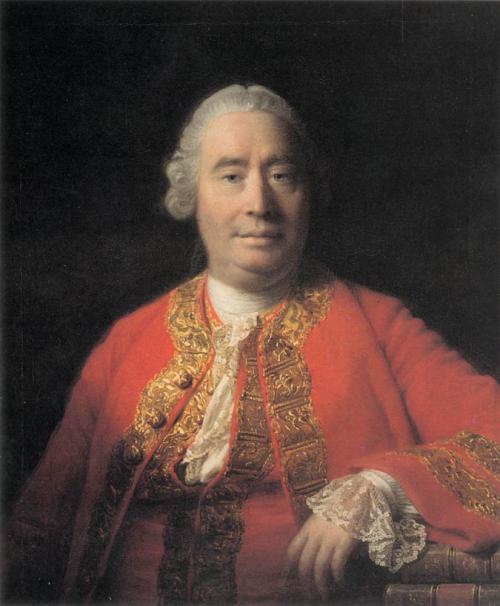 1766 door Allan Ramsay (English) 1766 door Allan Ramsay (English)Afbeelding afkomstig van Wikipedia (Nederlands) | |
| Externe links | |
| Geo | |
Terug naar Filosofie
 THUNK - 70. Hume's Fork, Logical Positivism, & Quine
  Three Minute Philosophy
| Analytisch | ||
| A | Waar per definitie | alleen waar door de woorden in de zinnen |
| B | Noodzakelijk | hun tegenovergestelde beweringen zouden een tegenspraak bevatten. Ze kunnen niet onwaar zijn |
| C | Apriori | de waarheid kan onafhankelijk van waarnemingen gekend worden |