Jacques Derrida (1930-2004): verschil tussen versies
Geen bewerkingssamenvatting |
Geen bewerkingssamenvatting |
||
| Regel 33: | Regel 33: | ||
{{#tag:easyview|Friedrich Nietzsche (1844-1900)|type=iframe|thumbnail=Friedrich Nietzsche}} is zijn grootte voorbeeld.<br> | {{#tag:easyview|Friedrich Nietzsche (1844-1900)|type=iframe|thumbnail=Friedrich Nietzsche}} is zijn grootte voorbeeld.<br> | ||
{| {{sys:table:class}} | {| {{sys:table:class}} | ||
|[[{{sys:w:en}}Phonocentrism|Phonocentrisme]] | |[[{{sys:w:en}}Phonocentrism|Phonocentrisme]] | ||
|is a concept that sounds and speech are inherently superior to (or "more natural" than) written language, or are regarded as such. To adherents of this philosophy, spoken language is inherently richer and more intuitive than written language. Phonocentrism holds that spoken language is the primary, fundamental way of communicating, and writing is merely a "second-rate" attempt to capture speech.<ref name="wen">Informatie afkomstig van [[{{sys:w:en}}Phonocentrisme|{{sys:w:name:en}}]]</ref> | |is a concept that sounds and speech are inherently superior to (or "more natural" than) written language, or are regarded as such. To adherents of this philosophy, spoken language is inherently richer and more intuitive than written language. Phonocentrism holds that spoken language is the primary, fundamental way of communicating, and writing is merely a "second-rate" attempt to capture speech.<ref name="wen">Informatie afkomstig van [[{{sys:w:en}}Phonocentrisme|{{sys:w:name:en}}]]</ref> | ||
Versie van 11 dec 2025 21:12
| Jacques Derrida | |
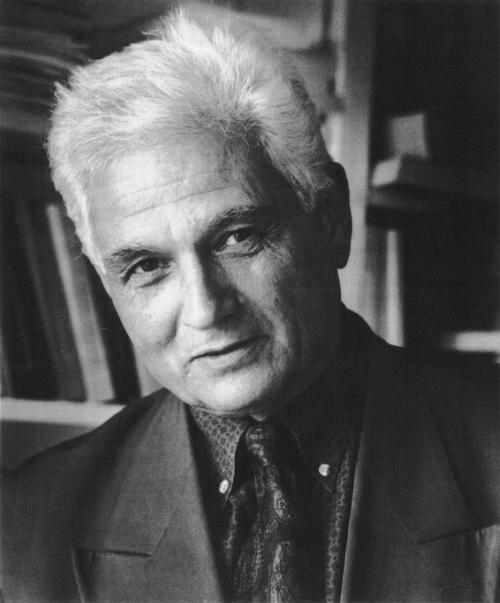 Afbeelding afkomstig van Department of Religious Studies Afbeelding afkomstig van Department of Religious Studies
| |
| Externe links | |
| Geo | |
Terug naar Filosofie
 Outtake from the movie "Derrida"
Beschrijving
Friedrich Nietzsche is zijn grootte voorbeeld.
| [[1]] | is a concept that sounds and speech are inherently superior to (or "more natural" than) written language, or are regarded as such. To adherents of this philosophy, spoken language is inherently richer and more intuitive than written language. Phonocentrism holds that spoken language is the primary, fundamental way of communicating, and writing is merely a "second-rate" attempt to capture speech.[1] |
| [[2]] | is a term coined by German philosopher [Klages|Ludwig Klages] in the 1920s. It refers to the tradition of Western science and philosophy that situates the logos, ‘the word’ or the ‘act of speech’, as epistemologically superior in a system, or structure, in which we may only know, or be present in, the world by way of a logocentric metaphysics. For this structure to hold true it must be assumed that there is an original, irreducible object to which the logos is representative, and therefore, that our presence in the world is necessarily mediated. If there is a Platonic Ideal Form then there must be an ideal representation of such a form. This ideal representation is according to logocentrist thought, the logos.[2] |
| Bronnen, noten en/of referenties: |